
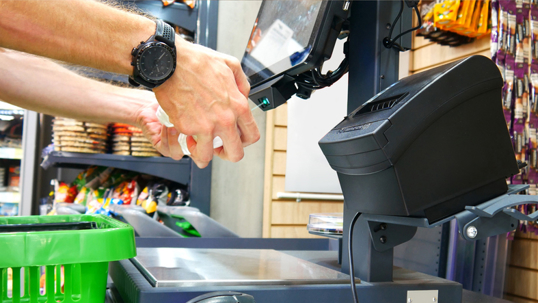
It may start as an ordinary trip to Walmart. You stop after work to pick up groceries and household items. You have a full cart of items. You use self-checkout. Maybe an item remains underneath the cart. Maybe something does not scan. Maybe you scan one item twice and another not at all. Or maybe Walmart believes something more deliberate happened.
You pay, put the receipt away, and start walking toward the exit.
Then someone approaches you.
“Can you come with me?”
A few minutes later, instead of loading groceries into your car, you may be sitting in a loss-prevention office trying to understand how a shopping trip turned into a possible criminal case.
For many of my clients, this is their first contact with the criminal justice system. They are embarrassed, frightened, and often confused about what happens next. Some insist it was an honest mistake. Others made a poor decision and immediately regret it. Either way, what happens in that Walmart loss-prevention office can have consequences that continue long after you leave the store.
If you have been accused of shoplifting at a Walmart in Jacksonville, Duval County, or elsewhere in Northeast Florida, here is what you need to understand.
Walmart Stops You Before You Leave. Can They Do That?
Potentially, yes. Florida law gives merchants certain authority to detain a person when the statutory requirements are satisfied.
Under Florida Statute § 812.015, a merchant, merchant's employee, or law-enforcement officer who has probable cause to believe retail theft has occurred may take the person into custody and detain the person in a reasonable manner and for a reasonable length of time for specified purposes.
That does not mean that every detention is automatically proper. The facts still matter.
But one common misconception is that Walmart has to stand by and wait until someone drives away before anything can happen. Florida's retail-theft law does not work that way.
What Happens in the Walmart Loss-Prevention Office?
This is often where the situation becomes very real.
Depending upon the circumstances, Walmart loss-prevention personnel may identify you, discuss the merchandise involved, review transaction information, preserve surveillance footage, document what they observed, and contact law enforcement.
Florida's retail-theft statute specifically recognizes electronic or digital imaging, security video, register tapes and register receipts within its provisions concerning antishoplifting and inventory-control devices.
In other words, a retail-theft case may involve considerably more than the statement of the employee who stopped you.
There may be video.
There may be a receipt.
There may be transaction records showing what was scanned.
There may be observations from loss-prevention personnel.
There may also be statements made by the accused person while sitting in that office.
Someone who is frightened may start talking because they believe that explaining everything will make the problem disappear. Sometimes people apologize even though they maintain that the failure to scan an item was accidental. Others try to explain several different things at once.
What was actually said—and the circumstances in which it was said—can become part of the evidence that must be evaluated later.
Does a Self-Checkout Mistake Automatically Mean You Committed Theft?
No.
The existence of unpaid merchandise does not eliminate the question of intent.
Florida Statute § 812.014 defines theft in terms of knowingly obtaining or using, or endeavoring to obtain or use, another person's property with the required intent to deprive the other person of a right or benefit in the property or to appropriate it to an unauthorized use.
Florida's retail-theft statute likewise defines retail theft to include certain conduct involving merchandise when accompanied by an intent to deprive the merchant of possession, use, benefit, or full retail value.
That distinction can matter enormously in a self-checkout case.
Consider two very different situations.
A shopper has a cart filled with $250 in groceries, pays for virtually everything, but a $12 package remains underneath the cart.
Another shopper repeatedly covers barcodes, intentionally scans less-expensive items in place of more-expensive merchandise, or deliberately passes numerous products around the scanner.
Those are not necessarily the same evidentiary case.
The State still has to prove the charged offense. The surrounding circumstances may therefore matter when determining whether the evidence establishes an intentional theft rather than a mistake. But circumstantial evidence can still be used.
Police Arrive. Am I Going to Jail?
Not necessarily.
Some people accused of misdemeanor retail theft are taken to jail. Others may receive a Notice to Appear or other court paperwork rather than being physically booked into jail, depending upon the circumstances and applicable law-enforcement procedures.
This creates another dangerous misconception.
A person walks out of Walmart, gets into the car and thinks:
“They let me go. Maybe this isn't really a criminal case.”
If you received a Notice to Appear requiring you to appear in court, you should treat it seriously. The fact that you were not transported to jail does not by itself mean that the criminal allegation disappeared.
The next phase may occur in court rather than in Walmart.
Then Walmart Tells You Not to Come Back
This is the part people frequently forget about until several days later.
You may be leaving the loss-prevention office when someone tells you that you are no longer permitted on Walmart property. You may receive paperwork. A law-enforcement officer or store representative may communicate a warning. If you receive a trespass warning in writing, do not ignore it.
Then life goes back to normal.
A week later you need groceries.
Or your spouse asks you to stop at Walmart.
Or you think:
“Surely they only meant that particular store.”
That assumption can create an entirely new problem.
A Shoplifting Case and a Trespass Warning Are Different Issues
The allegation that you committed theft and the question of whether you have permission to enter property are not the same legal issue.
Florida's trespass statutes address circumstances in which a person willfully enters or remains on property without authorization after the required notice or warning.
Do not guess about the meaning of a trespass warning.
If you were expressly told not to return, review exactly what you were given and exactly what you were told before going back.
“But Walmart Is a Public Store. Can't I Shop There?”
A privately owned retail store that is generally open to customers is not the same thing as public property that everyone has an unconditional right to enter.
Customers ordinarily enter because the business permits them to do so.
If that permission has been withdrawn as to a particular person, returning can present a different legal issue.
That is why the question “Can I go back to Walmart?” can be much more important than it initially sounds.
What If I Go to a Different Walmart?
Again, don't assume.
One of the first questions to ask is what the actual warning says and what was actually communicated to you.
Was the warning limited to the particular store?
Did the paperwork identify other property?
What exactly were you told?
Was a written warning provided?
Who issued it?
Those are factual questions. A person should not add to an existing petit-theft case by committing a criminal trespass simply because he or she assumed that another Walmart location was fine.
What Evidence Matters in a Walmart Shoplifting Case?
When I evaluate one of these cases, I am interested in the entire sequence of events—not simply the fact that Walmart says merchandise was unpaid.
Among the questions that may matter are:
What merchandise was allegedly not paid for?
What was its value?
How much merchandise did the customer actually purchase?
Was this self-checkout?
What does the surveillance footage show?
What does the receipt show?
What do the transaction records show?
Did an item fail to scan?
Was merchandise underneath the cart?
Was a different barcode allegedly scanned?
How many items are involved?
What did loss prevention actually observe?
What did the customer say?
Was there an alleged admission?
Were police called?
Was the person arrested or issued a Notice to Appear?
Was a trespass warning issued?
And perhaps most importantly:
What evidence does the State have that the conduct was intentional?
The answers can make two Walmart cases that look similar on paper very different when the evidence is actually examined.
Don't Let Embarrassment Make the Decisions for You
People accused of shoplifting are often deeply embarrassed.
That is especially true for someone with no criminal history who has a professional career, children, an immigration concern, a license, or simply has never imagined being accused of stealing.
Some want to plead guilty immediately just to make the experience end.
Others want to ignore the paperwork because they cannot believe a relatively inexpensive item has resulted in a criminal case.
Neither reaction substitutes for reviewing what actually happened.
A petit-theft allegation is still a criminal allegation. Before deciding how to resolve it, you should understand the evidence, the available defenses, the possible resolutions, and the consequences of the particular disposition being considered.
Frequently Asked Questions About Walmart Shoplifting Cases in Florida
Can I go back to Walmart after being accused of shoplifting?
It depends on whether Walmart or law enforcement issued or communicated a trespass warning and, importantly, what that warning actually says.
Do not assume that you can return simply because the criminal case has not been resolved—or because you were never taken to jail.
If you were told not to return, read any paperwork you received and have the scope of the warning clarified before returning.
Can I go to a different Walmart?
Do not assume that a warning applies only to the location where the incident occurred, and do not assume the opposite either.
The scope of the actual notice matters. Review the warning or paperwork you received before entering another Walmart location.
What happens if I return to Walmart after being trespassed?
Returning to property after authorization has been withdrawn will likely result in a separate trespass charge.
That means someone dealing with one misdemeanor case could create an additional legal problem by returning without first determining whether he or she is permitted to do so.
Does Walmart have to catch me outside the store before I can be accused of shoplifting?
No. Florida law provides merchants with detention authority under specified circumstances when there is probable cause to believe retail theft occurred. A case therefore does not necessarily depend upon a person reaching the parking lot or driving away.
Can Walmart detain me?
Florida Statute §812.015 allows a merchant, merchant's employee, or law-enforcement officer who has probable cause to believe retail theft has occurred to detain a person in a reasonable manner and for a reasonable period for the purposes authorized by the statute.
Whether a particular detention complied with the statute depends on the circumstances.
I forgot to scan one item. Is that automatically shoplifting?
Not automatically.
Intent is part of Florida's theft law. An unpaid item may certainly be evidence in a case, but the circumstances surrounding how and why the merchandise was not paid for can be important.
I paid for almost everything in my cart. Does that matter?
It can. Paying for $200 or $300 worth of merchandise does not automatically defeat a theft allegation involving another item. But the complete transaction can be relevant when evaluating what occurred and what evidence exists concerning intent.
I wasn't taken to jail. Do I still have a criminal case?
If you were given a Notice to Appear or other paperwork directing you to court, do not assume the matter disappeared simply because you went home rather than to jail.
Can Walmart drop the criminal charges?
Once there is a criminal case, only the State can drop the charges.
Is a first Walmart shoplifting charge serious?
It should be taken seriously even when the merchandise has relatively little value.
The precise classification and potential consequences depend on the value involved, the person's prior theft history, the particular charge and other circumstances. More importantly, how the case is ultimately resolved may matter beyond the immediate fine or sentence.
Should I just plead guilty if the item wasn't expensive?
Not before understanding the consequences and reviewing the evidence.
The price of the merchandise is only one issue. A criminal case can affect a person's record and may raise additional concerns depending upon employment, professional licensing, immigration status and other circumstances.
Before entering a plea, understand both the evidence against you and the consequences of the proposed resolution.
Accused of Shoplifting at Walmart in Jacksonville or Northeast Florida?
A Walmart shoplifting accusation can happen very quickly.
One moment you are checking out. The next you are in a loss-prevention office, speaking with police, holding a Notice to Appear and wondering whether you can ever walk into Walmart again.
The case should not be reduced to one sentence in a police report.
At the Law Offices of Kate Mesic, P.A., we represent individuals charged with petit theft and shoplifting in Jacksonville, Duval County and throughout Northeast Florida. We examine the evidence surrounding the alleged theft—including surveillance footage, receipts, loss-prevention observations, statements, and the circumstances bearing on intent—and evaluate the available defenses and possible resolutions.
If you have been accused of shoplifting at Walmart, contact our office to discuss what happened before making decisions about your criminal case.